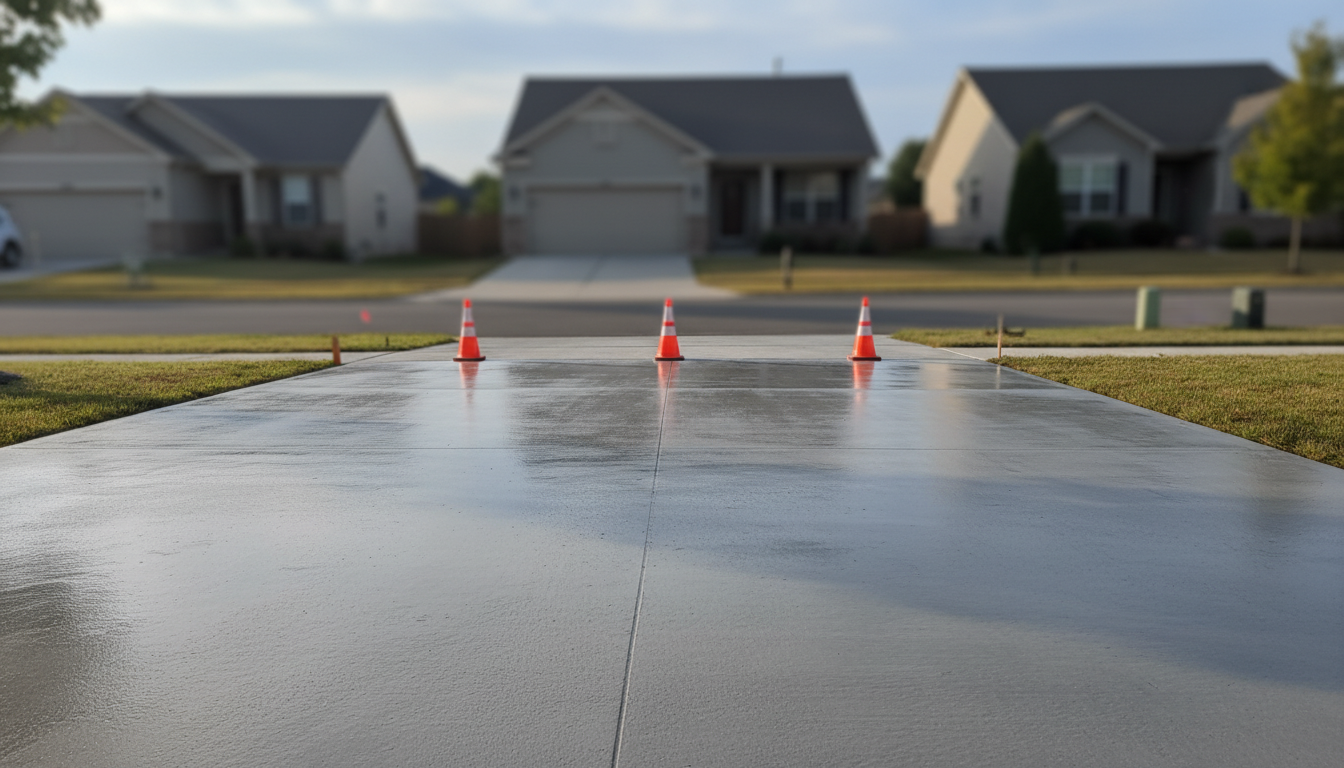
Stay off foot traffic for 24 hours, light vehicles for 7 days, and heavy loads or full use for 28 days. Those three numbers are the short answer for any new concrete driveway, including those poured on Nashville clay soil. The longer answer explains why, what can go wrong if the timeline is skipped, and how Nashville’s climate nudges the numbers in either direction.
The Standard Concrete Cure Timeline
Concrete hits roughly 70 percent of its design strength at 7 days and 99 percent at 28 days. Those two milestones drive every use-timing decision below.
First 24 hours
The slab has set but is still very soft. Foot traffic is OK for a brief walk-over; dragging objects, running pets, or dropping anything on the surface will leave permanent marks. Keep kids and pets off.
Days 1-7
Strength climbs fast. No vehicles. No heavy furniture staged on the slab. Keep the surface moist if a wet cure was specified; otherwise let curing compound do the work.
Day 7
Passenger cars (sedans, compact SUVs, minivans) can park, but do not turn the steering wheel while the vehicle is stationary. The twisting force on a single tire contact patch can mark softer concrete.
Days 7-28
Normal driving is fine. Avoid heavy trucks, RVs, trailers, and moving trucks if possible.
Day 28
Full design strength. Any vehicle, any normal use. This is also when a first coat of sealer can be applied if the contractor recommended one.
How Nashville Weather Shifts the Timeline
Concrete cures through a chemical reaction, not through drying, but the reaction is temperature-sensitive. Middle Tennessee sees both extremes.
Summer pours (June-August)
High temperatures speed early cure but also risk surface crazing and plastic shrinkage cracks. Most Nashville contractors require a 7-day wet cure in summer. Stay off as scheduled, but do not be surprised if surface damp-down continues for a full week.
Winter pours (November-February)
Cold slows the reaction. Below 50°F sustained, expect to add 2-3 days to every milestone. If overnight temperatures drop below 40°F within the first 48 hours, the contractor should use insulating blankets.
Spring and fall
Nashville’s ideal pour seasons. The 24/7/28 timeline holds without modification.
What Goes Wrong When You Skip the Timeline
Each stage has a specific failure mode if ignored.
- Walking too early (< 24 hrs): footprints, scuffs, permanent surface marks. Not repairable without resurfacing.
- Driving too early (< 7 days): tire impressions, cracking along wheel paths, possible full-depth failure at turn-in points.
- Heavy loads too early (< 28 days): structural cracking that may not show immediately but propagates over months.
- Turning the wheel on stationary tires (days 7-14): scuffed surface marks that look like cracks but are torn paste. Visible for life.
None of these are covered by typical contractor warranties because they are caused by premature use, not by defects.
How to Protect the Slab During Cure
- Block the entrance with cones or sawhorses until day 7 minimum.
- Keep lawn sprinklers from spraying the slab in the first 48 hours.
- If rain is forecast within 4 hours of finishing, the contractor should tent the slab.
- Do not apply any sealer, salt, or deicer within the first 30 days.
- Do not hose down the slab with pressure in the first 7 days.
| Stage | Time after pour | What's allowed | What to avoid |
|---|---|---|---|
| Set | 6-12 hours | Surface is walkable with extreme care | Any deliberate traffic |
| Initial cure | 24 hours | Light foot traffic | Pets, dragging, dropping tools |
| Early strength | 7 days | Passenger cars parked straight in | Turning wheels while stopped |
| Working strength | 14 days | Normal daily driving | Trucks, RVs, heavy loads |
| Full strength | 28 days | Any vehicle, any load, sealing OK | Deicing salt (avoid first winter) |
Action Plan for a New Concrete Driveway
- Block the driveway entrance for a full 7 days with cones or sawhorses.
- Keep pets, kids, lawn sprinklers, and bicycles off the slab for 24 hours minimum.
- Park passenger cars only on day 7 — no turning the wheel while stopped.
- Delay heavy trucks, RVs, and moving vans until day 28.
- Skip sealing and deicing salt for the entire first winter.
- In Nashville summer heat or winter cold, add 2-3 days to every milestone.
- Questions about your specific pour? Talk to a Nashville concrete contractor.