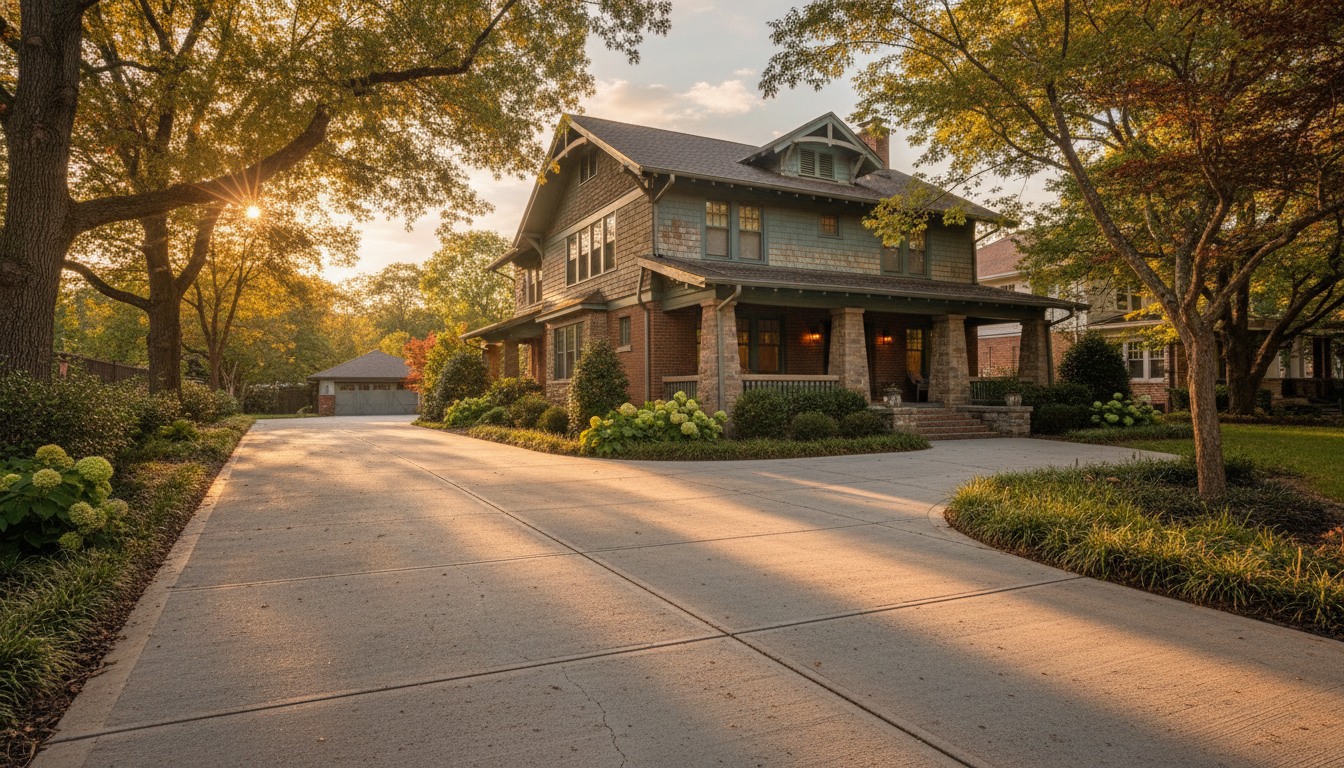
A properly installed concrete driveway typically lasts 25 to 35 years. On Nashville clay with bad prep, that drops to 12-15. With good prep and simple maintenance, the same driveway hits 40-plus. The spread between those numbers is bigger than most homeowners realize, and the variables that drive it are nearly all controllable at install time or through routine care afterward.
The 25-35 Year Baseline
Industry data from the Portland Cement Association and American Concrete Institute converges on a baseline of 25-35 years for residential concrete driveways built to standard specifications. That assumes 4000 PSI mix, 4-inch thickness, wire mesh or fiber reinforcement, control joints at 10-foot spacing, and a prepared subbase.
Above that baseline, properly maintained slabs on stable subgrades routinely reach 40-50 years. Below it, under-specified installs on expansive clay without drainage management can fail in 12-15 years. The difference is almost never about the concrete itself; it is about what is under, around, and on top of the slab.
The Five Factors That Control Lifespan
If the slab lasts 35 years or 15, the reason is almost always one of these five.
1. Base preparation
On Nashville clay, 6 inches of compacted #57 stone over geotextile fabric is the standard. Cutting that to 4 inches of gravel saves $600 on install and cuts 8-15 years off lifespan. This is the single biggest variable.
2. Concrete mix design
4000 PSI air-entrained concrete is the Nashville standard. 3000 PSI mixes (common in cut-rate bids) fail 30 percent faster under freeze-thaw. Fiber mesh or rebar reinforcement adds 5-10 years to the high end.
3. Joint spacing and cutting
Control joints every 8-10 feet for residential Nashville installs, cut within 12 hours of pour, to 1/4 the slab depth. Missing or late-cut joints are the #1 cause of random cracking.
4. Drainage
Water is the enemy of concrete. Roof water, surface runoff, and subsurface seepage all attack the slab from edges and underneath. Driveways that sit in standing water or receive downspout discharge lose 10+ years.
5. Maintenance
Two habits extend lifespan dramatically: sealing every 2-3 years, and not using deicing salt. Both cost almost nothing. Homeowners who do both regularly double the warranty-era lifespan.
What Nashville Soil and Climate Do to Lifespan
Middle Tennessee’s bull tallow clay is rated with a plasticity index of 50-130, meaning it swells and shrinks dramatically with moisture. On top of that, Nashville averages 60-plus freeze-thaw cycles per year. Both stress concrete in ways that milder climates do not.
The practical effect: a driveway built to minimum spec somewhere like Phoenix might last 35 years. The same spec in Nashville might last 20. Matching Nashville-specific prep (deeper base, 4000 PSI, closer joint spacing, drainage management) restores the full 30-35 year window. See concrete driveways on Nashville clay soil for the full technical walkthrough.
Signs a Concrete Driveway is Near End of Life
Not every crack means replacement time. But when several of the signs below show up together, the slab is approaching the end of useful life.
- Multiple problem types at once — cracks, sinking, and spalling all visible.
- Spalling across more than 30 percent of the surface.
- Cracks with vertical displacement in multiple locations.
- Hollow sounds under tap test indicating base washout under the slab.
- Standing water that will not drain, indicating the slab has lost its slope.
One or two of these usually still points to targeted repair. Three or more generally means replacement is the better financial path. See the full driveway repair guide for the decision framework.
Expected Lifespan by Install Quality
The single biggest predictor of how long a Nashville driveway lasts is what the contractor specified on install day. The table below shows the ranges to expect.
Concrete vs Asphalt Lifespan in Nashville
Asphalt driveways in Middle Tennessee typically last 15-20 years before needing replacement, with seal coating required every 3-5 years. Concrete at the same site lasts 1.5 to 2 times as long and needs less frequent maintenance.
Over a 30-year ownership window:
- Concrete: 1 install + sealing every 2-3 years. Total ownership cost roughly $1.25-$1.50 per sq ft per decade.
- Asphalt: Approximately 1.5 installs + seal coat every 3-5 years. Total ownership cost roughly $2-$2.50 per sq ft per decade.
See the full concrete vs asphalt cost comparison for the Nashville-specific numbers.
| Install quality | Spec | Expected lifespan | Typical outcome |
|---|---|---|---|
| Cut-rate | 3000 PSI, 3" thick, 4" gravel base, 12ft joints | 12-18 yrs | Widespread cracking by year 10 |
| Minimum standard | 3500 PSI, 4" thick, 4" stone base | 18-25 yrs | Localized repair needed by year 15 |
| Nashville standard | 4000 PSI, 4" thick, 6" #57 stone + fabric, 10ft joints | 25-35 yrs | Cosmetic attention only for decades |
| High-spec | 4000 PSI, 4" thick, 8" base + rebar, 8ft joints | 35-45 yrs | Still serviceable at resale |
Action Plan to Maximize Concrete Driveway Lifespan
- At install: demand 6" of #57 stone on fabric, 4000 PSI concrete, and 10-foot joint spacing.
- At install: make sure downspouts, grading, and surface slope route water away from the slab.
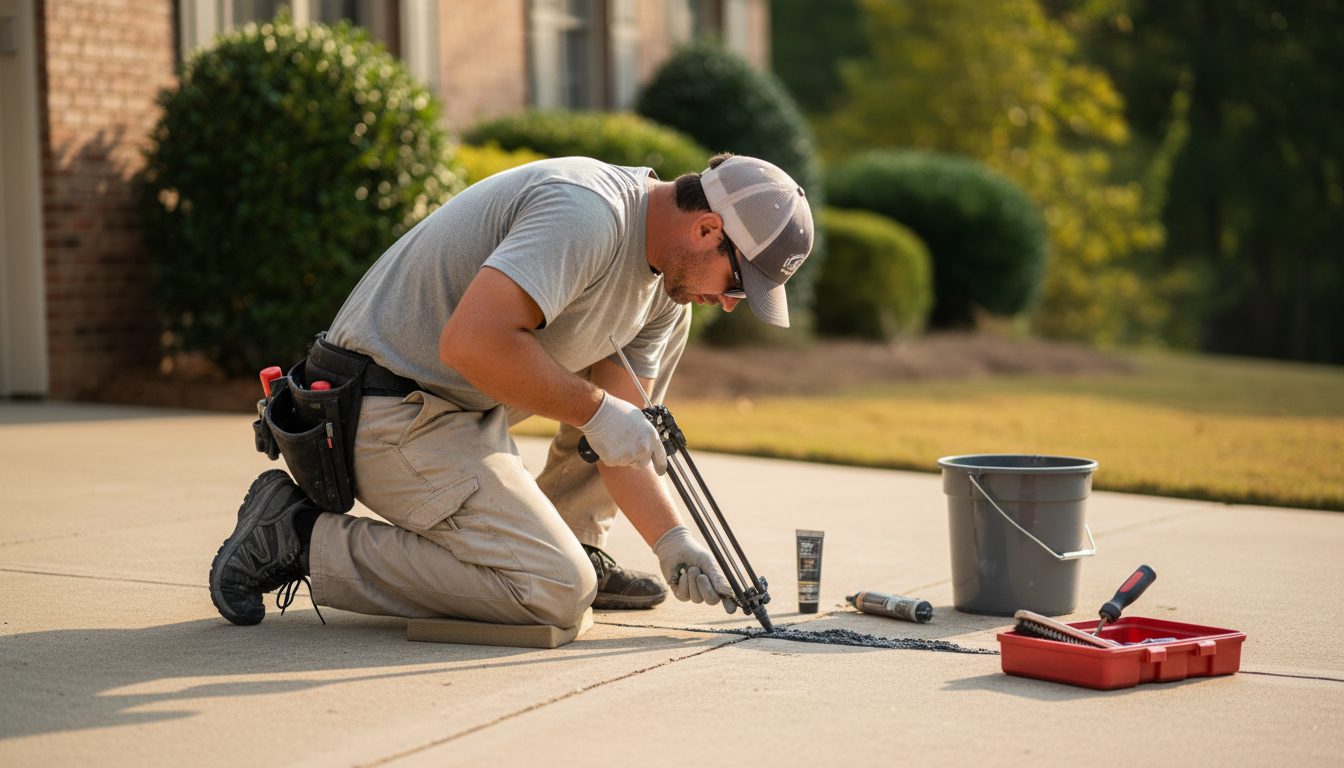
- Seal every 2-3 years with a quality acrylic or silane-based sealer.
- Reseal control joints annually with polyurethane joint sealant.
- Do not use deicing salt — sand, or calcium magnesium acetate if traction is critical.
- Address small cracks and drainage issues early; they compound fast on Nashville clay.
- Starting a new install? Request a quote.