Driveway repair in Nashville is rarely one-size-fits-all. Middle Tennessee homeowners deal with expansive clay soil, 60-plus freeze-thaw cycles a year, and summer heat that can push concrete surface temperatures past 130°F. Each of those conditions drives a different failure mode, and each failure mode has a different right answer. This guide walks through every common problem Nashville homeowners face, what causes it, what it costs to fix, and how to tell when repair stops making sense and replacement starts making more.
The Five Categories of Nashville Driveway Problems
Nearly every repair call in Middle Tennessee falls into one of five buckets. Identifying which one matters because the fix, the cost, and the risk of recurrence are different for each.
1. Cracks (hairline, structural, displacement)
Cracks are the most common issue and the most over-repaired. Hairline shrinkage cracks narrower than 1/8 inch are usually cosmetic. Structural cracks wider than 1/8 inch, cracks with vertical displacement, or cracks that grow season over season signal base or reinforcement failure and need more than a surface seal.
2. Sinking and settlement
A section of driveway that has dropped 1/2 inch or more typically indicates base washout, soil consolidation, or expansive clay movement. Common near downspouts, driveway approaches, and edges. Usually fixable with slab lifting (polyjacking or mudjacking) rather than replacement.
3. Surface damage (spalling, scaling, pitting)
Flaking, chipping, or rough-feeling surface patches are almost always caused by water absorption plus freeze-thaw, often accelerated by deicing salt. The underlying slab is usually sound; the fix is resurfacing or an overlay, not replacement.
4. Drainage problems
Water pooling on the slab, running toward the foundation, or cutting channels along the edge will eventually cause every other problem on this list. Solving drainage first makes every other repair more durable. See the Nashville driveway drainage guide for options.
5. Joint failure
Control joints and expansion joints that have opened, filled with debris, or lost their sealant let water reach the base. Rejoint and reseal work is cheap, fast, and prevents most of the other four problems from forming in the first place.
How to Diagnose Your Nashville Driveway Problem
Before calling any contractor, a 10-minute walk-around with a tape measure, a level, and a phone camera will save money. Here is what to look for.
Crack width test
Use a credit card. If the crack is narrower than the card, it is likely cosmetic. If the card goes in easily, it is structural. If one side of the crack is higher than the other, it is displacement, which always means a base problem.
Level test
Lay a 4-foot level across any suspicious area. A gap greater than 1/4 inch under the level indicates settling. If water pools at that same spot after rain, add it to the list.
Joint audit
Walk the driveway and photograph every control joint, expansion joint, and edge where the slab meets a garage, walkway, or curb. Note which ones are open, filled with weeds, or missing sealant.
Downspout and slope check
Where does roof water go when it leaves the downspouts? If any of it runs toward or onto the driveway, that is a root cause, not a symptom. Fix it before repairing anything.
Nashville Driveway Repair Methods Compared
Once the problem is identified, match it to the right repair method. The table below shows the options Nashville contractors actually use, with typical 2026 local cost ranges. All prices assume a standard residential driveway of 500-700 square feet.
When Repair Makes Sense vs When to Replace
The decision point is rarely obvious. The rule that holds up across most Nashville driveways is this: if the total repair cost approaches 50 percent of replacement cost, replace it. For a 600 sq ft driveway, replacement runs roughly $4,500 to $8,000. Once repairs cross $2,500, the math starts to tip.
Other flags that point to replacement rather than repair:
- Driveway is 25+ years old with multiple problem types appearing at once.
- Widespread spalling across more than 30 percent of the surface.
- Multiple sunken sections suggesting base failure across the whole slab.
- Base was originally undersized for Nashville clay (4 inches of gravel or less).
- Drainage cannot be corrected without re-grading the slab.
If none of these apply, targeted repair is usually the better financial choice. For a full cost walk-through of replacement, see the Nashville concrete driveway cost guide.
DIY vs Professional Driveway Repair
Some repairs are genuinely homeowner-friendly. Others aren't, not because they're technically hard, but because the consequences of getting them wrong are expensive. Here's a split that matches what most Nashville homeowners actually experience.
Real Nashville Repair Cost Ranges in 2026
Pricing below reflects typical residential work from licensed Middle Tennessee contractors. Quotes 25 percent below these ranges often skip steps like joint routing, base inspection, or proper curing. Quotes 25 percent above usually include premium sealants, extended warranties, or unusual access conditions.
- Crack sealing: $0.50–$2.00 per linear foot. Minimum job $150–$250.
- Joint routing and resealing: $1.50–$4.00 per linear foot.
- Polyjacking (foam slab lifting): $6–$12 per sq ft of lifted area.
- Mudjacking (slurry slab lifting): $4–$8 per sq ft of lifted area.
- Surface resurfacing / overlay: $3–$7 per sq ft.
- Structural patching (full depth): $8–$15 per sq ft.
- Section replacement: $10–$16 per sq ft (includes saw cut, removal, pour, cure).
- Full driveway replacement: $7–$14 per sq ft installed.
Homeowners budgeting for repair should also add 10 percent for access issues, hidden base problems, or HOA-required design adjustments. Run numbers through the Nashville concrete cost calculator for project-specific estimates.
Preventing the Next Repair
The cheapest repair is the one that never has to happen. Four habits prevent roughly 80 percent of the problems described above.
- Seal every 2-3 years. $150-$300 of sealer blocks the water infiltration that causes spalling and freeze-thaw damage.
- Reseal joints annually. A $30 tube of polyurethane joint sealant keeps base-damaging water out.
- Manage downspouts. Route roof water at least 6 feet from the slab edge. Do not let it cross the driveway.
- Do not use deicing salt. Sand or calcium magnesium acetate instead. Rock salt accelerates spalling dramatically on Nashville-age concrete.
Homeowners who follow these steps on a properly built driveway regularly get 35-plus years before major repair is needed. See how to prevent concrete cracking for a deeper walkthrough.
| Method | Best for | Typical cost | Lifespan gain | Risk of recurrence |
|---|---|---|---|---|
| Crack sealing | Hairline cracks < 1/8" | $0.50–$2/lf | +5-10 yrs | Low |
| Joint routing & reseal | Failed control/expansion joints | $1.50–$4/lf | +5 yrs | Low if base is sound |
| Polyjacking | Sunken slabs, fast cure | $6–$12/sq ft | +10-15 yrs | Low |
| Mudjacking | Sunken slabs, budget option | $4–$8/sq ft | +8-12 yrs | Moderate on wet clay |
| Resurfacing / overlay | Surface spalling, cosmetic | $3–$7/sq ft | +10-15 yrs | Moderate if base fails |
| Structural patch | Localized full-depth damage | $8–$15/sq ft | +15 yrs | Low |
| Section replacement | Widespread damage in one area | $10–$16/sq ft | +25 yrs | Very low |
| Full replacement | End-of-life or multi-problem slab | $7–$14/sq ft | +25-35 yrs | Very low |
DIY Repair — Appropriate For
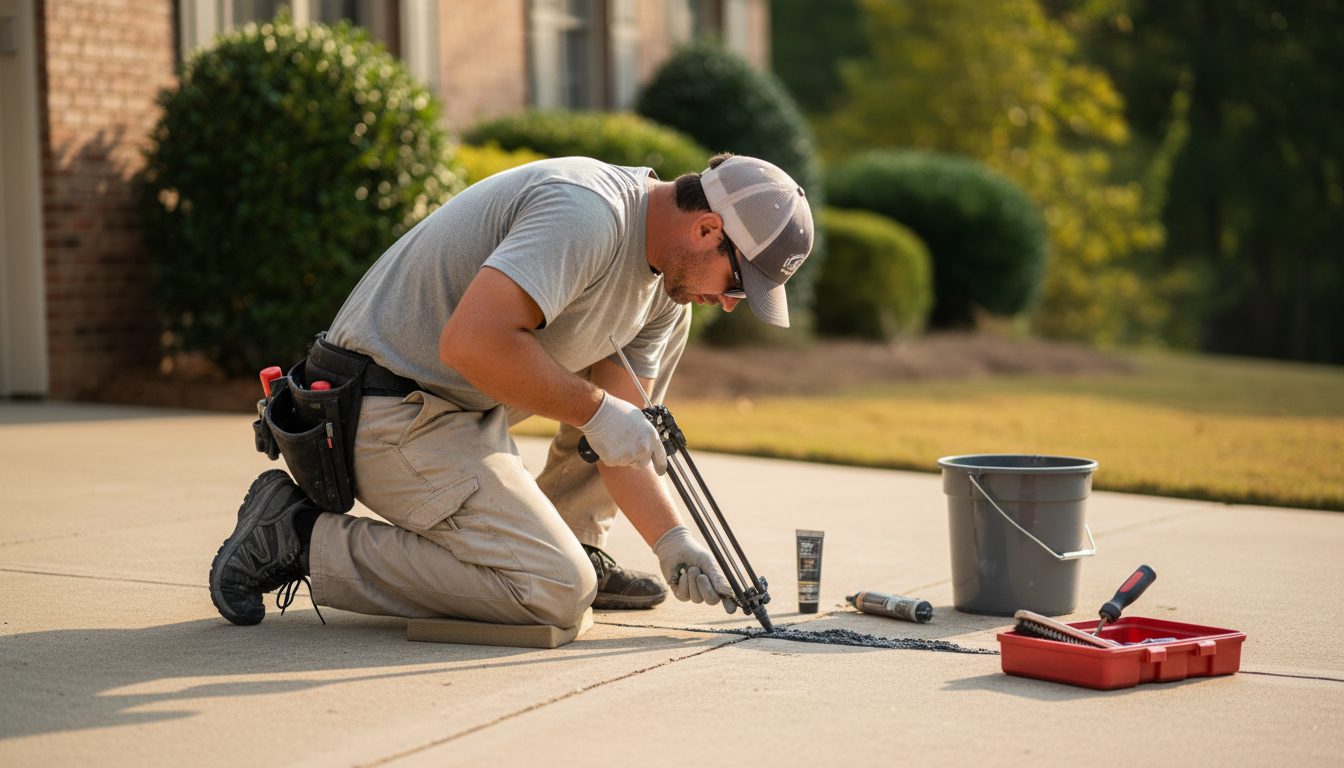
- Sealing hairline cracks with polyurethane crack filler (~$15 per tube)
- Resealing control joints with backer rod + sealant
- Applying a fresh coat of acrylic driveway sealer every 2-3 years
- Removing weeds and resealing edge where slab meets lawn
- Clearing debris from expansion joints before winter
Call a Professional — Appropriate For
- Any crack with vertical displacement (base problem, not a crack problem)
- Sunken slabs — polyjacking / mudjacking requires specialized equipment
- Structural patches requiring saw cutting and rebar splicing
- Resurfacing or overlays that require bonding agent and substrate prep
- Any work near a garage apron, walkway, or foundation where slope matters
Action Plan for a Driveway Repair in Nashville
- Start with a 10-minute self-assessment: crack width, level test, joint audit, downspout check.
- Identify the root cause before choosing the fix — a repair that ignores drainage or base problems won't last.
- For damage under 30 percent of the surface and an under-20-year-old driveway, repair is almost always the right call.
- Match the method to the problem: crack seal, joint reseal, slab lift, resurface, or patch.
- Get at least two written quotes with line-item scope. 25 percent-below-average quotes usually skip critical steps.
- After any repair, seal every 2-3 years and reseal joints annually to protect the investment.
- Request a free on-site assessment for projects you aren't sure about.