Concrete driveway resurfacing in Nashville typically runs $3 to $7 per square foot, a fraction of the $7-$14 per square foot that full replacement costs. For a driveway with a sound base but a tired, stained, or lightly spalled surface, resurfacing is often the right call. For a slab with base failure or structural cracking, it is a waste of money. This guide explains exactly which situation is which, what the resurfacing process looks like on Middle Tennessee clay, and how to decide.
What Driveway Resurfacing Actually Is
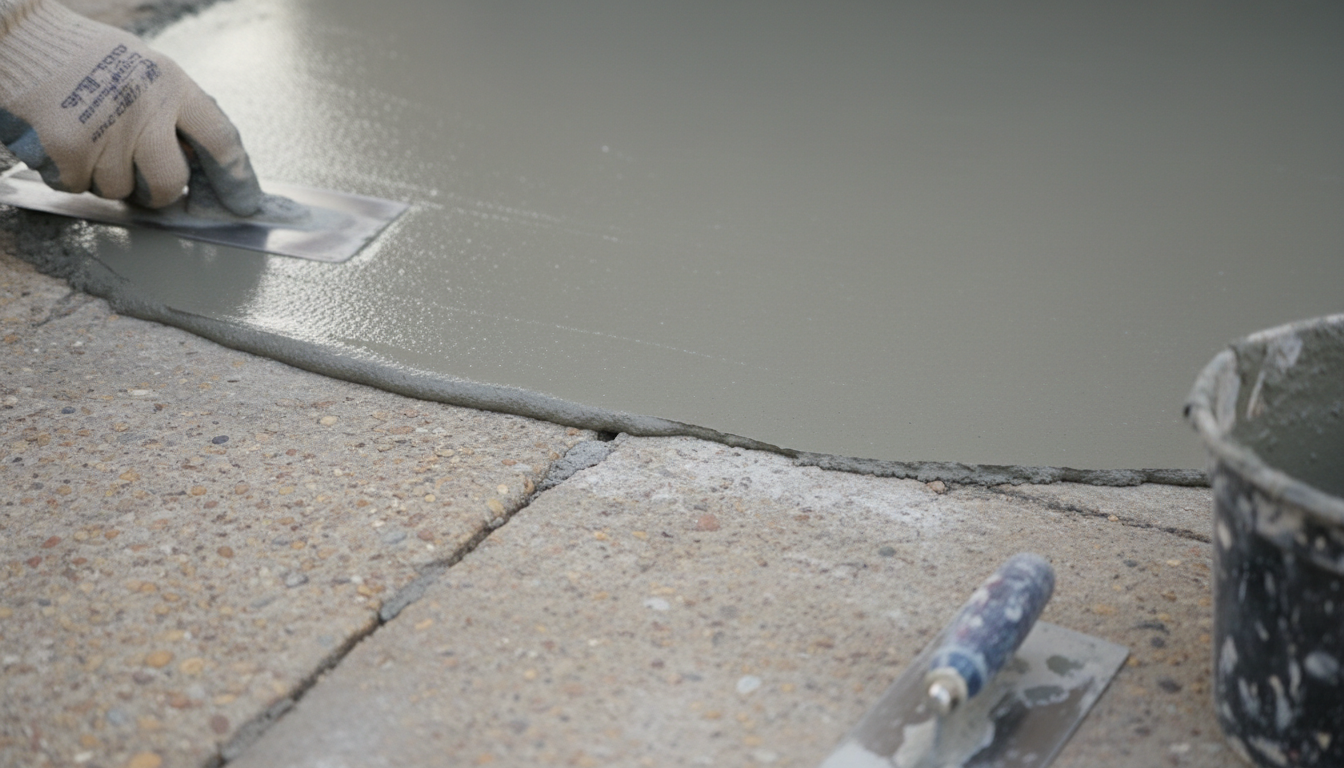
Resurfacing (also called overlay or recapping) bonds a thin new layer of concrete, polymer-modified concrete, or specialty topping to an existing slab. The existing slab stays in place; only the top surface changes. Thickness ranges from about 1/4 inch for a decorative skim coat up to 2 inches for a structural overlay.
Why homeowners choose it
Two reasons drive most resurfacing work in Nashville. First, cost: resurfacing runs half to a third of replacement for the same square footage. Second, time: resurfacing is typically a 1-2 day job versus 5-7 days for removal and replacement. Curb appeal returns without the disruption.
What it cannot do
Resurfacing is cosmetic-to-moderate structural. It cannot fix a slab that is sinking, a base that has washed out, or drainage that sends water toward the house. Those problems require real repair (polyjacking, base rebuilding, grading) before any overlay makes sense.
Resurface vs Replace: How to Decide
The decision is nearly always visible at the surface if you know what to look for. Use this checklist in order.
- Is the slab sinking or uneven? If yes, lift first (polyjacking or mudjacking), then decide on resurfacing. Do not overlay an unlevel slab.
- Are cracks wider than 1/4 inch or showing displacement? If yes, that’s a structural problem. Resurfacing will crack through.
- Is more than 30 percent of the surface spalled or scaled? If yes, resurfacing is borderline. 50 percent+, replacement is cleaner.
- Is the base sound? Tap test with a hammer. A hollow sound indicates void spaces under the slab — not a resurfacing candidate.
- Is the driveway under 20 years old? Most slabs this age have good base and reinforcement. Resurfacing buys another 10-15 years.
If checks 1 and 2 pass and the slab is under 20 years old with a sound base, resurfacing is almost always the better financial choice. If checks 1, 2, or 4 fail, replacement is the honest answer regardless of what a contractor says.
Types of Concrete Resurfacing Available in Nashville
Not all overlays are the same. The four options below cover nearly every Nashville driveway project.
Micro-topping (1/16" - 1/4")
Polymer-modified cement slurry applied like paint. Purely cosmetic, restores color and fills minor pitting. Lifespan 5-8 years. Cheapest option at $2-$4 per sq ft.
Standard overlay (1/4" - 1/2")
Self-bonding concrete mix, often with fiber reinforcement. The most common Nashville choice. Good for surface spalling, light cracking, and cosmetic renewal. $3-$5 per sq ft. Lifespan 10-15 years.
Stamped or decorative overlay (1/4" - 1")
Standard overlay with a textured stamp or color tint pressed into the fresh surface. Mimics stone, brick, or tile. $7-$12 per sq ft. Lifespan similar to standard overlay, 10-15 years with maintenance. See the stamped concrete cost guide for details.
Structural overlay (1" - 2")
Full concrete overlay with wire mesh or rebar. Handles moderate surface cracking and light settlement. $5-$8 per sq ft. Lifespan 15-20 years. Requires the existing slab to be mechanically roughened and bonding agent applied.
The Nashville Resurfacing Process Step by Step
A well-executed resurface looks the same regardless of which overlay type is used. Skipping any of these steps guarantees early failure.
- Inspection. The contractor walks the slab, identifies structural issues, and decides if resurfacing is viable at all.
- Surface cleaning. Pressure washing at 3000+ PSI, degreasing if oil stains exist. The slab must be spotless.
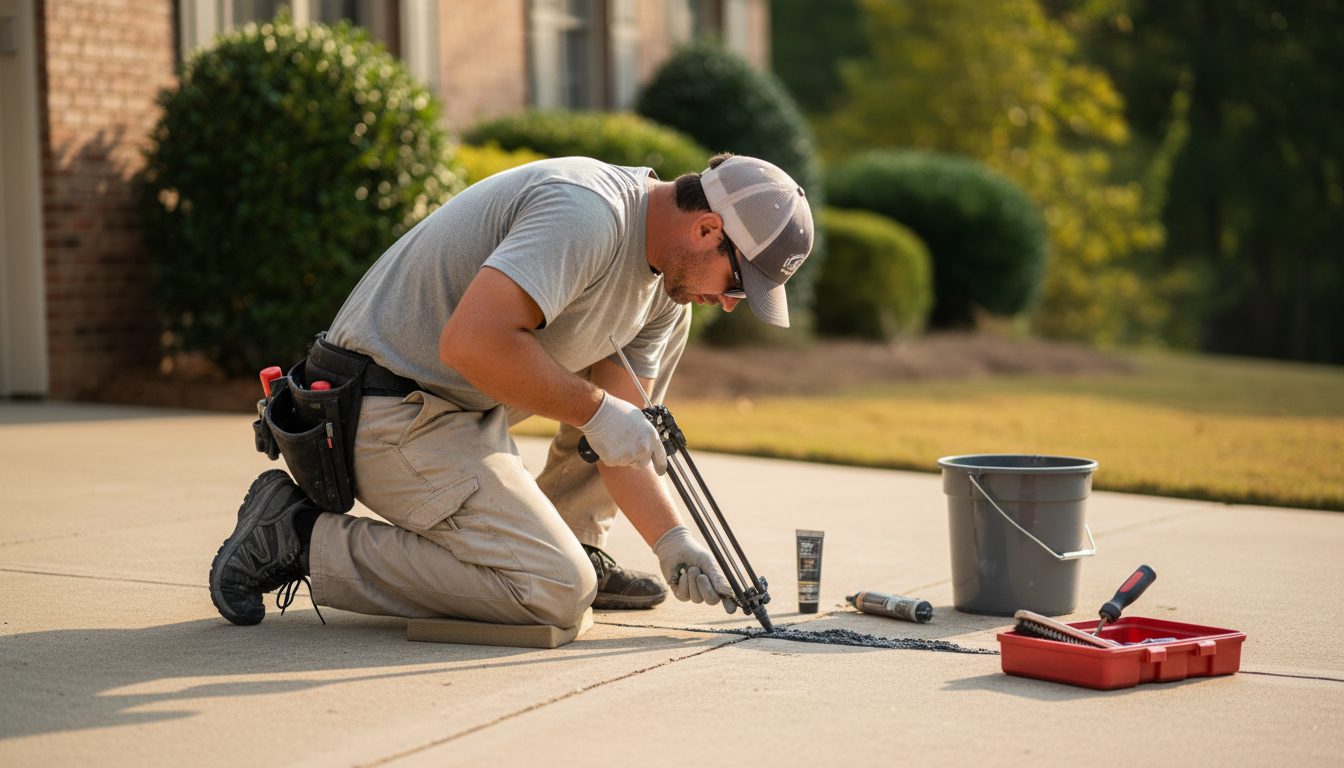
- Crack repair. All cracks wider than 1/8 inch are routed and filled before the overlay goes down.
- Mechanical roughening. Shot blasting, grinding, or acid etching to create a profile the overlay can bond to.
- Bonding agent. A polymer bonding slurry applied to the damp slab just before the overlay pour.
- Overlay placement. The new mix is poured, screeded, and floated. Fiber-reinforced mixes are common in Nashville.
- Finishing. Broom finish for grip, trowel finish for smooth, or stamp/texture for decorative.
- Joint matching. The overlay must have control joints cut to match the existing slab joints, or cracking is guaranteed.
- Cure. Standard 28-day full cure with 24/7/28 use timeline. See how long to stay off a new concrete driveway.
Resurfacing vs Replacement at a Glance
Both paths have trade-offs. The right answer depends on what the existing slab looks like, the budget, and how long the driveway needs to last.
Real Nashville Resurfacing Costs in 2026
Quoted ranges assume a typical 500-700 sq ft residential driveway with normal access. Complex shapes, heavy stain removal, or extensive crack routing push costs toward the upper end.
- Micro-topping: $2-$4/sq ft — $1,000-$2,800 total
- Standard overlay: $3-$5/sq ft — $1,500-$3,500 total
- Structural overlay: $5-$8/sq ft — $2,500-$5,600 total
- Stamped overlay: $7-$12/sq ft — $3,500-$8,400 total
For comparison, full replacement in Nashville runs $4,500 to $10,000 for the same driveway. Use the Nashville cost calculator for project-specific estimates.
How Long a Resurfaced Driveway Lasts in Nashville
A properly resurfaced driveway on Nashville clay, with maintained sealing and drainage, lasts 10-15 years before the overlay itself needs attention again. The underlying slab continues to function for decades beyond that; resurfacing does not shorten its life.
The biggest failure modes are:
- Bond failure: Almost always caused by inadequate surface prep. Overlay delaminates in sheets.
- Reflective cracking: Existing cracks in the base slab telegraph through the overlay. Prevented by proper crack routing and joint matching.
- Freeze-thaw scaling: Happens if the overlay is not sealed or if deicing salt is used before it has fully cured.
None of these are inevitable. All three are prevented by choosing a contractor who does the full 9-step process and by sealing every 2-3 years after cure.
| Overlay type | Thickness | Best for | Cost/sq ft | Lifespan |
|---|---|---|---|---|
| Micro-topping | 1/16"–1/4" | Cosmetic renewal, color restoration | $2–$4 | 5-8 yrs |
| Standard overlay | 1/4"–1/2" | Surface spalling, light damage | $3–$5 | 10-15 yrs |
| Structural overlay | 1"–2" | Moderate cracking, reinforcement | $5–$8 | 15-20 yrs |
| Stamped / decorative | 1/4"–1" | Cosmetic upgrade with pattern | $7–$12 | 10-15 yrs |
When to Resurface
- Base slab is structurally sound and not sinking
- Surface damage is cosmetic or under 30 percent coverage
- Driveway is under 20 years old
- Budget is 40-60 percent of replacement cost
- Want decorative upgrade without full tear-out
When to Replace Instead
- Slab has sunken sections or displaced cracks
- More than 30 percent spalling or widespread damage
- Driveway is 25+ years old with multiple problems
- Base sounds hollow on tap test (void spaces below)
- Drainage cannot be corrected without re-grading
Action Plan for Driveway Resurfacing in Nashville
- Do the 5-point resurface-vs-replace check before calling any contractor.
- If the base is sound and damage is cosmetic, resurfacing saves 40-60 percent vs replacement.
- Match overlay type to the problem: micro-topping for color, standard for spalling, structural for moderate cracks, stamped for upgrade.
- Demand the full 9-step process: inspection, clean, crack repair, roughen, bond, overlay, finish, joint match, cure.
- Budget $3-$7/sq ft for standard overlay on a Nashville-sized driveway.
- Plan for 28 days to full use and no sealer or deicing salt for the first 60 days.
- Not sure if your slab is a resurface or replace candidate? Get a free on-site assessment.